
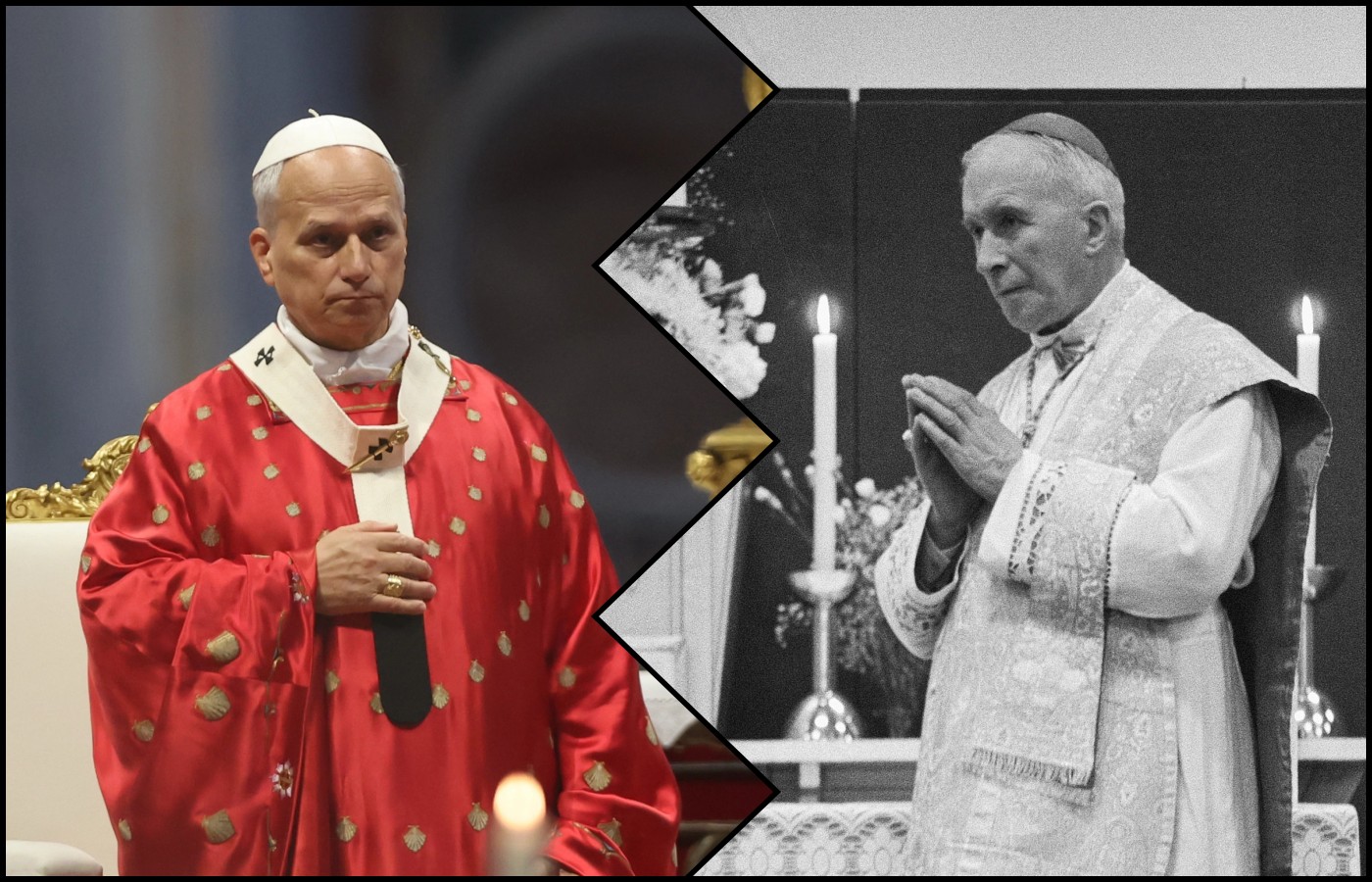
 Pope Leo XIV/The late Archbishop Marcel Lefebvre
On July 2, 2026, the Apostolic See issued ipso facto a latae sententiae excommunication of four priests “ordained” to the episcopate within and by the Society of Saint Pius X (SSPX), as well as the bishop who acted as co-consecator in the liturgical celebration.[1]zenit.org The priests were elevated to the level of bishop without the express permission and authority of the Pope. The Vatican added:
Clergy and lay faithful are warned not to adhere to the schism of the Priestly Society of Saint Pius X, as they would automatically incur the penalty of latae sententiae excommunication. —Zenit, July 2, 2026
This has caused new divisions, if not the birth of a new schism in the Church…
A Brief History
The SSPX was founded by Archbishop Marcel Lefebvre with the intention of training young men to offer the Old Mass[2]Latin rite with the approval of the Diocesan Ordinary. But in 1974, “in a spirit of indignation, ” Abp. Lefebvre issued a declaration refusing to “follow the Rome of neo-Modernist and neo-Protestant tendencies which were clearly evident in the Second Vatican Council and, after the Council, in all the reforms which derived from it.”[3]sspx.org The following year, both his local Ordinary and Pope Paul VI suppressed the SSPX.
However, in disobedience to the canonical warning issued, Abp. Lefevre went on to ordain priests without permission. As a result, on July 23, 1976, he was suspended ad divinis,[4]A suspension which forbids the exercise of every act of the power of orders which one obtained either by sacred orders or by privilege. depriving him of the right to exercise the priesthood.
Whether or not one agrees with the suppression, these actions are perfectly within the Supreme Pontiff’s authority. The First Vatican Council teaches:
Wherefore we teach and declare that, by divine ordinance, the Roman church possesses a pre-eminence of ordinary power over every other church… So, then, if anyone says that the Roman pontiff has merely an office of supervision and guidance, and not the full and supreme power of jurisdiction over the whole church, and this not only in matters of faith and morals, but also in those which concern the discipline and government of the church dispersed throughout the whole world; or that he has only the principal part, but not the absolute fullness, of this supreme power; or that this power of his is not ordinary and immediate both over all and each of the churches and over all and each of the pastors and faithful: let him be anathema. —Vatican I, Fourth Session, Chapter Three
In an unpublished paper by Br. Jonas Houston on the history of the SSPX and their actions, he notes how Abp. Lefevre had increasingly separated himself from the authority of the Catholic Church:
- He disregarded the Church’s request to revoke his 1974 Declaration
- Ignored the effects of lawful suspension, continuing to act as a bishop when suspended a divinis
- Disregarded warnings to ordain priests without permission
- Sent priests to minister without incardination or mission (usurping the authority of the local Bishops)
- Sent priests to minister who were under censure
- Ignored the lawful suspension from the exercise of holy orders
- Preached in dioceses without permission from the local bishop
- Promoted public hostility to the popes and the Holy See, referring to both Paul VI and John Paul II as “antichrists”
- Publicly propagated errors
- Went on to found a schismatic tribunal that claims the authority to annul marriages and religious vows
- Opened chapels, seminaries, “religious communities,” and schools all over the world
“Despite all this,” notes Br. Jonas, “Pope John Paul II and Cardinal Joseph Ratzinger, then head of the Congregation for the Doctrine of the Faith, sought to reconcile with the SSPX. Through Cardinal Ratzinger, Abp. Lefebvre was offered a bishop for his Society on August 15, 1988. As part of this agreement, the SSPX would have been granted the status of a personal prelature with a worldwide canonical mission, and a bishop whom the Holy Father would choose from a list of names presented by Abp. Lefebvre, and the ability to incardinate priests into their society.” Furthermore, Rome was to establish a commission to investigate the validity of the laity’s past reception of the sacraments by SSPX priests (such as marriages) and to further regularize the Latin Mass as a personal prelature “with the official blessing of Holy Mother Church.”
Abp. Lefebvre signed the proposed agreement on May 5, 1988… but then reneged the very next day. After this, and despite being warned several times directly by the Supreme Pontiff and the Holy See not to proceed with what, according to John Paul II, “cannot but appear as a schismatic act,” Apb. Lefebvre then illegally consecrated four bishops on June 30, 1988.[5]Joseph Bizeg, A Study of Consecrations Against the Will of the Pope, pg. 14-15
An Act of Schism
The actions of Apb. Lefebvre — and the SSPX today — are, ironically, a violation of Catholic Tradition and divine law — ironic, since the SSPX claims that they are upholding Sacred Tradition within their Society. And to a large degree, they have been faithful. However, Jesus Christ alone chose the Apostles. In handing the “keys of the kingdom” to Peter, this divine right was assigned to the Vicar of Christ, as explicated in Church teaching:
For the right of ordaining bishops belongs only to the Apostolic See, as the Council of Trent declares; it cannot be assumed by any bishop or metropolitan without obliging Us to declare schismatic both those who ordain and those who are ordained, thus invalidating their future actions. —POPE PIUS VI, Charitas (April 13, 1791), n. 10
Pius VI’s declaration was further affirmation of the Apostolic Constitution Super Solidate:
He who would wish to take from the Roman Pontiff the sovereign authority which he has to make these assignments [of bishops] would find himself under the necessity of impugning the legitimacy of succession of the multitude of bishops who, all over the world, govern individual churches, and for the government of which these prelates have received their mission from the Sovereign Pontiff. Therefore, it is impossible, without causing very great disturbance in the Church, and without exposing episcopal authority itself to imminent danger, it is impossible to attack this great and marvelous assemblage of power which God has deigned to grant to the Chair of Peter; power in virtue of which, as St. Leo the Great says, “Peter personally governs all those whom Jesus Christ governs principally: in such wise that if Jesus Christ has willed that there should be something in common between Peter and the other Princes of the Church, it is only through (and by) Peter that He has given what He has not refused to the others” (Serm. IV, in anniv. suae assumpt.). —cf. English translation here
Nor was Pius VI the only pope to address the authority of the Pontiff on the election of bishops:
The writings of the ancients testify that the election of Patriarchs had never been considered definite and valid without the agreement and confirmation of the Roman Pontiff. … Everyone knows that the eternal and at times the temporal happiness of people depends on the proper election of bishops; the circumstances of time and place must be considered, referring all the authority for selecting the bishops to the Apostolic See… no man has the power to renounce a divine right [e.g. Marcel Lefebvre] which he might at some time be compelled to exercise by the will of God Himself. —PIUS IX, Quartus Supra (1873)
His successor would add:
From what We have said, it follows that no authority whatsoever, save that which is proper to the Supreme Pastor, can render void the canonical appointment granted to any bishop; that no person or group, whether of priests or of laymen, can claim the right of nominating bishops; that no one can lawfully confer episcopal consecration unless he has received the mandate of the Apostolic See. Consequently, if consecration of this kind is being done contrary to all right and law, and by this crime the unity of the Church is being seriously attacked, an excommunication reserved specialissimo modo to the Apostolic See has been established which is automatically incurred by the consecrator and by anyone who has received consecration irresponsibly conferred. —POPE PIUX XII, Ad Apostoloroum principis, n. 47-48
The Council of Trent was more blunt:
…those who, of their own rashness, assume them to themselves [the ordination of bishops] are not ministers of the church, but are to be looked upon as thieves and robbers, who have not entered by the door —Session 23, Ch. 4
The Basis for Rebellion
Not unlike Martin Luther, the SSPX believes itself to be the bastion of the Catholic faith, that they alone are the true Church. In the words of Abp. Lefebvre himself:
It is not we who are in schism but the Conciliar Church… we are talking about a counterfeit version of the Church, and not the Catholic Church… It is no longer the Catholic Church. We are suspended a divinis by the conciliar church, of which we do not want to be a part. This conciliar church is schismatic, because it breaks with the Catholic Church of all time. It has its new dogmas, its new priesthood, its new institutions, its new liturgy, already condemned by the Church in many official and definitive documents… Rome has lost the Faith, my dear friends. Rome is in apostasy. These are not words in the air. It is the truth. Rome is in apostasy. They have left the Church. This is sure, sure, sure. It is a schismatic council. The Church, which affirms such errors, is both schismatic and heretical. This Conciliar Church is therefore not Catholic. To whatever extent the Pope, bishops, priests, or faithful adhere to this new Church, they separate themselves from the Catholic Church. The Novus Ordo Mass is a bastard rite. The Novus Ordo sacraments are bastard sacraments. The Novus Ordo priests emerging from the Novus Ordo seminaries are bastard priests. It is a Church that I do not recognize. I belong to the Catholic Church…It is, therefore, a strict duty for every priest wanting to remain Catholic to separate himself from this Conciliar Church for as long as it does not rediscover the Tradition of the Church and of the Catholic Faith. —Spiritual Conference, given in Econe, 21 June 1978, published in Sel de Terre, #50, p. 244
His position is absolute: the Church post-Vatican II is no longer Catholic. With one swipe, he declares the entire Church in communion with the Pope — her eastern and western churches alike — to be apostates.
The idea, however, that the Church at some point in the future would be preserved in her entirety by a single random bishop should strike even the casual observer as vain, let alone a contradiction of Matthew 16:18. For in one stroke, Lefebvre has cast aside the Church’s teaching on Her indefectibility and visibility, clearly taught prior to Vatican II:
And, so that the Episcopate also might be one and undivided, and so that, by means of a closely united priesthood, the multitude of the faithful might be kept secure in the oneness of faith and communion, He set Blessed Peter over the rest of the Apostles. And He fixed in him the abiding principle of this two-fold unity with its visible foundation, by the strength of which the eternal Temple would be built up, and the Church, in the firmness of that faith, would rise up, bringing her sublimity to Heaven. —Pastor Aeternus, Dogmatic Constitution of Pius IX (1846-1878)
Pope Leo XIII would also affirm these hallmarks of the Church, citing several Church Fathers:
St. John Chrysostom concurs: “I say and protest (he writes) that it is as wrong to divide the Church as to fall into heresy” (Hom. xi., in Epist. ad Ephes., n. 5). Wherefore as no heresy can ever be justifiable, so in like manner there can be no justification for schism. “There is nothing more grievous than the sacrilege of schism….there can be no just necessity for destroying the unity of the Church” (S. Augustinus, Contra Epistolam Parmeniani, lib. ii., cap. ii., n. 25).
Certainly Christ is a King for ever; and though invisible, He continues unto the end of time to govern and guard His church from Heaven. But since He willed that His kingdom should be visible… “For the same reason, therefore, because He was about to withdraw His visible presence from the Church, it was necessary that He should appoint someone in His place, to have the charge of the Universal Church. Hence before His Ascension He said to Peter: ‘Feed my sheep’.” (St. Thomas, Contra Gentiles, lib. iv., cap. 76). —Satis Cognitum, n. 10-11
The visibility of the Church is found, thus, not in the claimed orthodoxy of this or that group (the Donatists, Novations, Protestants, and Sedevacantists have all claimed to be the true Church), but particularly in the Vicar of Christ himself,[6]“The Pope, Bishop of Rome and Peter’s successor, “is the perpetual and visible source and foundation of the unity both of the bishops and of the whole company of the faithful.” “For the Roman Pontiff, by reason of his office as Vicar of Christ, and as pastor of the entire Church has full, supreme, and universal power over the whole Church, a power which he can always exercise unhindered.” —Catechism of the Catholic Church, n. 882 and those in communion with him. Jesus declared Peter to be the rock and foundation of the Church (Matt 16:18). “From this text,” says Leo XIII, “it is clear that by the will and command of God the Church rests upon St. Peter, just as a building rests on its foundation.”[7]Satis Cognitum, n. 12
But Lefebvre says the Church now rests on the SSPX.
We [the SSPX] truly represent the Catholic Church as it was before, because we continue what it has always done. It is we who have the notes of the visible Church: One, Holy, Catholic, and Apostolic. That is what makes the visible Church. —La Visibilite de L’eglise, Marcel Lefebvre
This statement is only formal evidence that Lefebvre had lost faith in Christ and His Church, built upon the rock of Peter.
It must be the necessary condition of stability and strength. Remove it and the whole building falls… The words — and the gates of Hell shall not prevail against it — proclaim and establish the authority of which we speak…. “What is the it?” (writes Origen)… [It’s] as if the rock and the Church were one and the same. I indeed think that this is so, and that neither against the rock upon which Christ builds His Church nor against the Church shall the gates of Hell prevail” (Origenes, Comment. in Matt., tom. xii., n. ii). The meaning of this divine utterance is, that, notwithstanding the wiles and intrigues which they bring to bear against the Church, it can never be that the Church committed to the care of Peter shall succumb or in any wise fail. —POPE LEO XIII, Satis Cognitum, n. 12
Prophetic Warnings
A number of Catholic seers around the world have spoken of a coming schism and division in the Church. In a message to Servant of God Fr. Stefano Gobbi and the Marian Movement of Priests dated June 29, 1998, Our Lady was unequivocal:
The heart of the Pope is bleeding today because of one bishop of the holy Church of God who, through an arbitrary episcopal ordination carried out against his [the Pope’s] will, is opening up a painful schism in the Catholic Church. (On June 30, 1988, Archbishop Marcel Lefebvre (SSPX) illegally consecrated four bishops against the will of the Supreme Pontiff, John Paul II, and the Holy See.) But this is only the beginning…
To the American seer, Jennifer, whose messages were given to Pope John Paul II and subsequently encouraged to be promoted, Our Lord gave this warning, with accompanying signs:
You will suffer great financial difficulties. You will see division in My Church. You will see a great famine and storm after storm. —June 12, 2003; cf. wordsfromjesus.com
You have begun to see the division in My Church for too many of My chosen sons have fallen to the ways of the world. For, as I have told you, priest will be against priest and nun against nun. —December 25, 2003
This echoes the warning given by Our Lady at Akita, Japan.
The work of the devil will infiltrate even into the Church in such a way that one will see cardinals opposing cardinals, bishops against bishops. —to the late Sr. Agnes Sasagawa of Akita, Japan, October 13th, 1973
In northern Italy, Our Lady allegedly appeared to stigmatist Marco Ferrari with this message:
My children, as I said in Fatima, there will be a great division and schism in the Church: pray children, pray! Satan is unchained and is tormenting the whole world. —January 1, 2016
Also in Italy, Our Lady of Zaro allegedly said to Angela on March 26, 2020 (the day after Countdown to the Kingdom was launched):
Pray that the authentic Magisterium of the Church would not be lost. My beloved Church will go through the great tribulation and the great purification; there will be a schism within Her. —cf. countdowntothekingdom.com
Pray for the Holy Father: pray, children. The Church will have to face bad times — there will be a great schism. —June 8, 2022
The arguments against the post-Vatican II Church, elucidated by Abp. Lefebvre, are the same ones promoted today by self-described “traditionalist” podcasters and media outlets, with equal disillusionment with recent popes. Their arguments are essentially along the lines:
- Since Vatican II, modernism has swept through vast portions of the Church
- Vatican II documents contain error
- The liturgical reforms have ruined the Mass, and we must return to the Old Rite
- The Pope is following a globalist agenda
- The Pope is causing scandal by ill appointments and confusing documents and statements
- Ecumenism is preparing for a false religion, etc.
To be certain, the points they make contain some merit; their grievances are often valid; their frustration understandable. I, too, am saddened by the present state of our Church and what seems to be a double standard: faithful or “conservative” Catholics are often censured while heterodox or “liberal” Catholics are rarely chastised.
At the same time, many of these voices go too far. They often disregard magisterial teaching in favor of their own reasoning; they dangerously flirt with schism, fomenting division by hyperanalyzing every single flaw and foible of the hierarchy; and they seem to have an allergy to nuance, preferring everything in black and white. But even some of Jesus’ sayings were not crystal clear.
While I will tackle some of these issues such as Vatican II and the liturgy in future writings, it is enough to say as a sort of preamble: Ambiguity is not heresy; deficiencies in the new liturgy do not invalidate it; papal flaws and pastoral blunders do not annul legitimate authority; lazy or inept clergy do not disqualify them; and Vatican II, a legitimate ecumenical council by every canonical standard, was led by the Holy Spirit like every other council in the Church’s 2000-year history, even if its application thereafter was seized upon by revolutionaries and heretics. When in doubt, every magisterial teaching must be interpreted through a hermeneutic of continuity with the past, not a hermeneutic of suspicion and malevolence.
Otherwise, we risk becoming the very instruments of division we seek to avoid. In repeated admonitions from Our Lady to Brazilian seer, Pedro Regis, she has said:
Accept the teachings of the true Magisterium of the Church of My Jesus. You are heading for a future of great confusion and division. Those who do not remain faithful to the Church of My Jesus will be dragged into the abyss of false doctrines. Be attentive in order not to be deceived. —January 5, 2021
It’s easy to see how SSPX members, for instance, could say that they are doing that very thing, and that by remaining in the “conciliar church”, one will be “dragged into the abyss of false doctrines.” But as we’ve seen above, the “true Magesterium of the Church” has spoken clearly on what is, and where the Catholic Church resides — there, with Peter.
Where Peter is, there is the Church! —St. Ambrose of Milan
Simple case in point: for all of Pope Francis’ sometimes shocking statements and appointments, Sacred Tradition remains fully intact, even if it has been bruised, misconstrued, or misrepresented,[8]read What is the True Magisterium? for The Papacy is Not One Pope.
The Emerging Schism
So now, we see emerging a threefold division in the Church: 1) the SSPX “traditionalist” sect, who claims to be the “true Church”; 2) Catholics fully faithful to Catholic Tradition, but who remain in communion with Peter’s successor; 3) those Catholics who, seizing the ambiguity of some post-conciliar concepts and Francis’s pontificate, are creating a false church that departs from Tradition.[9]cf. The Black Ship and The Black Ship – Part II Prior to the current break of the SSPX with Rome, theologian Fr. Thomas Weinandy spoke already of an “internal papal schism.”
…we perceive a situation, ever-growing in intensity, in which on the one hand, a majority of the world’s faithful — clergy and laity alike — are loyal and faithful to the pope, for he is their pontiff, while critical of his pontificate, and, on the other hand, a large contingent of the world’s faithful — clergy and laity alike — enthusiastically support Francis precisely because he allows and fosters their ambiguous teaching and ecclesial practice.
What the Church will end up with, then, is a pope who is the pope of the Catholic Church and, simultaneously, the de facto leader, for all practical purposes, of a schismatic church. Because he is the head of both, the appearance of one church remains, while in fact there are two.
The only phrase that I can find to describe this situation is “internal papal schism,” for the pope, even as pope, will effectively be the leader of a segment of the Church that through its doctrine, moral teaching, and ecclesial structure, is for all practical purposes schismatic. This is the real schism that is in our midst and must be faced… —Fr. Thomas Weinandy, theologian, The Catholic Thing, October 8, 2019
If ever there was a moment to break from the Church, it was when Peter denied Christ, Judas betrayed Him, and the other apostles scattered into hiding. But the nascent Church ultimately didn’t abandon the bleeding Body of Christ (figuratively and literally). Rather, they corrected and exhorted each other to faithfulness, including the first pope,[10]cf. Gal 2:11-14 as they strove to be “of the same mind, with the same love, united in heart, thinking one thing.” [11]Philippians 2:2
Jesus promised that the gates of hell would not prevail against His Church — not that it would be free from weak men, mistakes, and cowardice, from unwise pastoral directives, laziness, or ineptitude. Still, Jesus established an order, a hierarchy,[12]cf. The King and His Royal Court that He expected to be obeyed, despite these frailities among both the shepherds and laity. Without this obedience in a spirit of humility and charity, the gates of hell will, in fact, do significant damage, as much as modernity and heresy have already done.
As I’ve said in the past, the only sound you’ll hear if you abandon the Barque of Peter is “splash!”
So grateful for your prayers and support.
Thank you!

To journey with Mark in The Now Word,
click on the banner below to subscribe.
Your email will not be shared with anyone.
Now on Telegram. Click:

Follow Mark and the daily “signs of the times” on MeWe:
Listen on the following:




Footnotes
| ↑1 | zenit.org |
|---|---|
| ↑2 | Latin rite |
| ↑3 | sspx.org |
| ↑4 | A suspension which forbids the exercise of every act of the power of orders which one obtained either by sacred orders or by privilege. |
| ↑5 | Joseph Bizeg, A Study of Consecrations Against the Will of the Pope, pg. 14-15 |
| ↑6 | “The Pope, Bishop of Rome and Peter’s successor, “is the perpetual and visible source and foundation of the unity both of the bishops and of the whole company of the faithful.” “For the Roman Pontiff, by reason of his office as Vicar of Christ, and as pastor of the entire Church has full, supreme, and universal power over the whole Church, a power which he can always exercise unhindered.” —Catechism of the Catholic Church, n. 882 |
| ↑7 | Satis Cognitum, n. 12 |
| ↑8 | read What is the True Magisterium? |
| ↑9 | cf. The Black Ship and The Black Ship – Part II |
| ↑10 | cf. Gal 2:11-14 |
| ↑11 | Philippians 2:2 |
| ↑12 | cf. The King and His Royal Court |