
or on YouTube
I received this letter from a Protestant reader:
Mark, I appreciate this blog and Searching for God. As a Protestant, I have problems with you continually referring to messages reportedly from the mother of Jesus, for whom there is no biblical suggestion that she even communicates with us humans. Mary was a sinner, as we are, even though we should honor her. I appreciate your blog when you use biblical references and also those of great saints in the church. Being a Catholic should not keep you from asking yourself those types of questions.
The reader has raised a number of points which I will try to answer as briefly as possible. The main question here is whether or not the Virgin Mary, whom Tradition teaches was assumed into Heaven, can still communicate with her spiritual children who are still on earth?
Why Mary was Preserved from Sin
There is a secondary point my reader raises, claiming that “Mary was a sinner, as we are.” I will briefly touch on this, since it will lead us to the first objection of my reader.
2000 years of Tradition affirm that, by virtue of the merits of Christ’s Passion, the Mother of Jesus was preserved from sin. This grace was given to her at the moment of her conception (what we call the “Immaculate Conception”).[1]Note: when the angel Gabriel greets Mary in Luke 1:28, he says, “Hail, full of grace! The Lord is with you” [as translated by St. Jerome in the Latin Vulgate]. Luke’s use of the Greek word kecharitōmenē for “full of grace” indicates that God has already “graced” Mary previous to this point, making her a vessel who “has been” and “is now” filled with divine life [footnote RSV]. Because Mary held within her womb the “Word of God”, the Ark of the Covenant is seen as a type of the Virgin Mary. And the Ark was required to be made of “pure gold” [cf. Exodus 25:11]. Ontologically speaking, she was preserved from original sin in order that Christ’s own body, taken from her flesh, would be “unblemished” — the spotless “Lamb of God” who would become a sinless offering on behalf of mankind.
This would bear enormous significance, not only for our salvation but sanctification — when the Church 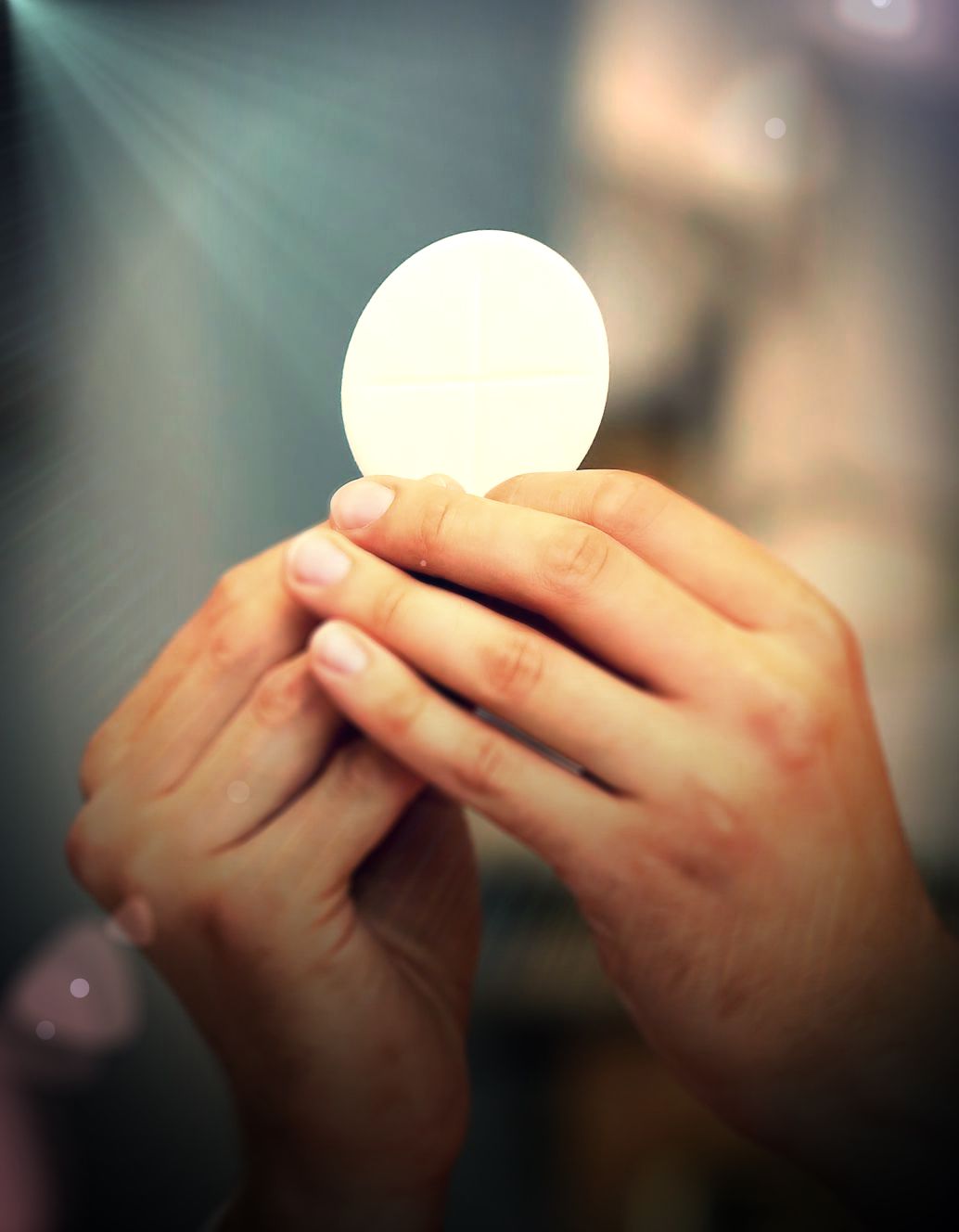 would follow Christ’s command to eat His Body and drink His Blood “in memory of Me” (Luke 22:19).
I am the living bread that came down from heaven; whoever eats this bread will live forever; and the bread that I will give is My flesh for the life of the world. (John 6:51)
Jesus wanted His Church to participate in a literal partaking of His Flesh and Blood. But how could His flesh provide eternal life unless it was also preserved from the stain of (original) sin?
Whoever eats my flesh and drinks my blood has eternal life, and I will raise him on the last day. For my flesh is true food, and my blood is true drink. (John 6:54-55)
As a footnote to this, Our Lady appeared on March 25, 1858, to St. Bernadette Soubirous in the grotto of Massabielle, Lourdes, France, and revealed her identity to the young girl by saying, “I am the Immaculate Conception.” Unbeknownst to the simple, uneducated 14-year-old Bernadette was that, four years prior, the dogma of the Immaculate Conception had been officially defined by Pope Pius IX.[2]December 8, 1854; when a pope “defines”, he is not creating a new dogma but affirming what the Church has always believed.
As a further sign of Heaven’s benediction of this Marian dogma, Our Lady instructed Bernadette to dig the ground near the grotto. When she began scratching away at the mud, a spring welled up which, to this day, continues to flow at Lourdes. Over 7,000 healings have been reported there (though the number officially recognized by the Church as “miraculous” is 72).
Of course, my Protestant reader does not accept that Mary could even appear to and speak to her spiritual children, such as St. Bernadette, in the first place.
Is Mary Our Mother?
I say “spiritual children” for two reasons — and this is important, because it ultimately forms part of the answer to our central question on the authenticity of Marian apparitions.
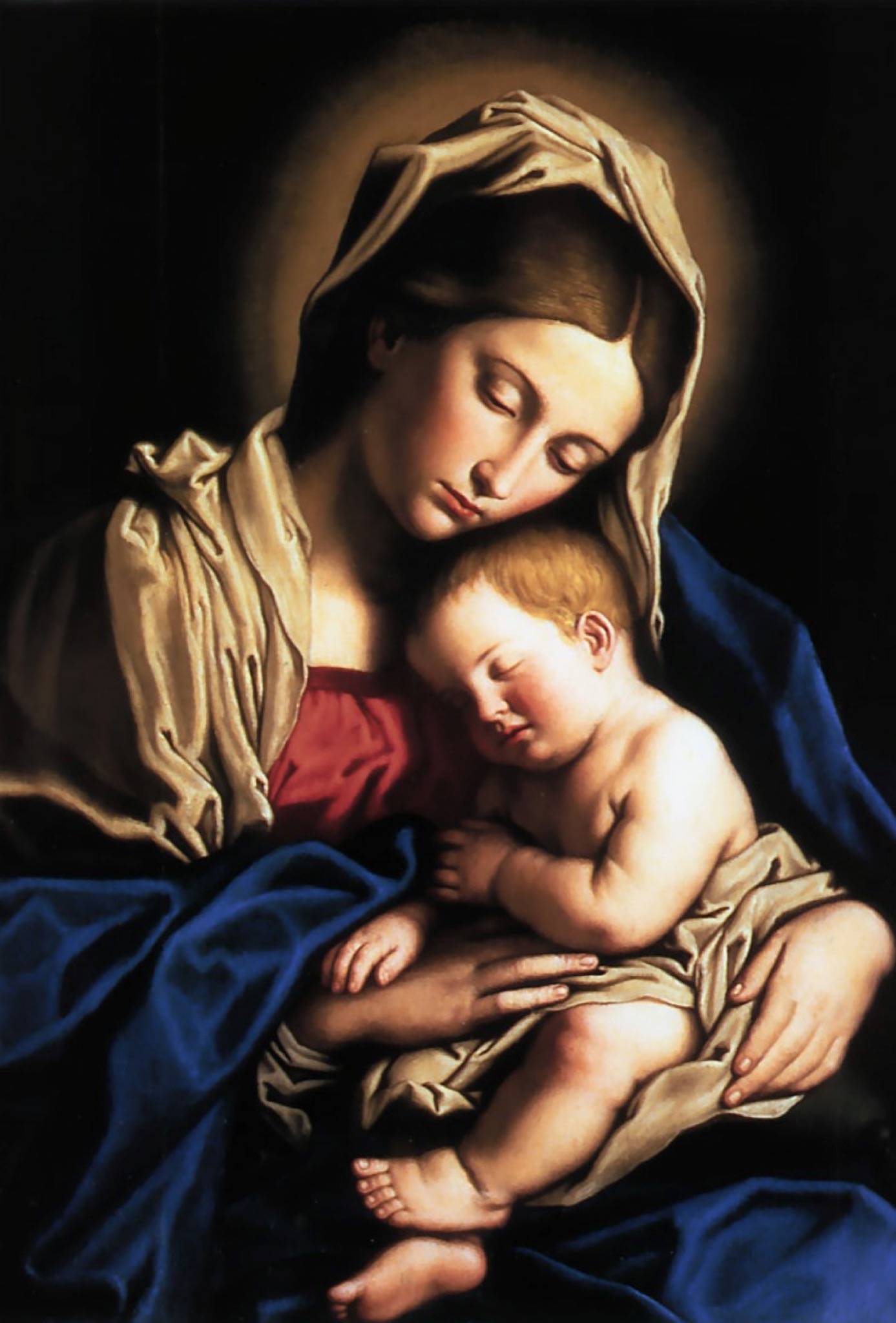
First, Elizabeth affirms Mary’s motherhood when she exclaims, “How is it that the mother of my Lord should come to me?” (Luke 1:43) Jesus, in turn, affirms Mary as the mother of His mystical Body,[3]The Scriptures teach that Jesus is essentially the “new Adam” in 1 Corinthians 15:22: “For just as in Adam all die, so too in Christ shall all be brought to life.” As such, the Early Church Fathers saw Mary as the “new Eve.” Church Father St. Irenaeus (c. 125 – c. 202 AD) wrote: “He, having been made Himself the beginning of those that live, as Adam became the beginning of those who die. Wherefore also Luke, commencing the genealogy with the Lord, carried it back to Adam, indicating that it was He who regenerated them into the Gospel of life, and not they, Him. And thus also it was that the knot of Eve’s disobedience was loosed by the obedience of Mary. For what the virgin Eve had bound fast through unbelief, this did the virgin Mary set free through faith” [Against Heresies (Book III, Chapter 22). And who was Eve again? Genesis 3:20: “The man gave his wife the name ‘Eve,’ because she was the mother of all the living.” the Church, represented beneath the Cross by John:
When Jesus saw his mother and the disciple there whom he loved, he said to his mother, “Woman, behold, your son.” Then he said to the disciple, “Behold, your mother.” And from that hour the disciple took her into his home. (John 19:26-27)
 In a new decree designating the Monday after Pentecost as the feast of “Mary, Mother of the Church,” Cardinal Robert Sarah explains:
In some ways this [title] was already present in the mind of the Church from the premonitory words of Saint Augustine and Saint Leo the Great. In fact the former says that Mary is the mother of the members of Christ, because with charity she cooperated in the rebirth of the faithful into the Church (De Sancta Virginitate, 6), while the latter says that the birth of the Head is also the birth of the body (Sermon 26), thus indicating that Mary is at once Mother of Christ, the Son of God, and mother of the members of his Mystical Body, which is the Church. These considerations derive from the divine motherhood of Mary and from her intimate union in the work of the Redeemer, which culminated at the hour of the cross. —Decree on the Celebration of the Blessed Virgin Mary, Mother of the Church, in the General Roman Calendar; February 11, 2018
Finally, this motherhood is affirmed again in Revelation 12 where we read of the apparition of a “woman clothed in the sun” as she labors to give birth to a male child, an allusion to Jesus. But she gives birth to not only Christ:
…the dragon became angry with the woman and went off to wage war against the rest of her offspring, those who keep God’s commandments and bear witness to Jesus. (12:17)
This Woman represents Mary, the Mother of the Redeemer, but she represents at the same time the whole Church, the People of God of all times, the Church that at all times, with great pain, again gives birth to Christ. —POPE BENEDICT XVI, Castel Gandolfo, Italy, August 23, 2006; Zenit; cf. catholic.org
I would be remiss if I did not quote a famous Protestant who did not question Mary’s spiritual motherhood:
Mary is the Mother of Jesus and the Mother of all of us even though it was Christ alone who reposed on her knees… If He is ours, we ought to be in His situation; there where He is, we ought also to be and all that He has ought to be ours, and His mother is also our mother. —Martin Luther, Sermon, Christmas, 1529.
Can the Saints Speak to Us?
 All of this brings us to the initial objection: that there is no biblical evidence that Mary “even communicates with us humans.” On the contrary, there is plenty of biblical evidence that those who have died can not only be granted a window into our lives here on earth, insofar as God deigns, but that they can even appear to us on earth. For example, in Revelation 6, we read how the martyrs are made aware of the sacrifices that must continue on earth for a time:
Each of them was given a white robe, and they were told to be patient a little while longer until the number was filled of their fellow servants and brothers who were going to be killed as they had been. (Revelation 6:11)
We also read that the elders who stand continually before the throne of God offer to Him the prayers of those on earth, which is why both the Old and New Testament People of God have always believed in the intercession of the saints:
Each of the elders held a harp and gold bowls filled with incense, which are the prayers of the holy ones. (Revelation 5:8)
LORD Almighty, God of Israel, hear the prayer of the dead of Israel, children who sinned against you; they did not listen to the voice of the LORD, their God, and their evils cling to us. (Baruch 3:4)
One of the earliest mentions in Scripture of actual appearances of the deceased is of the prophet Samuel to Saul. It’s a controversial passage because Saul actually visits a medium in order for her to conjure up Samuel. But necromancy, the occult practice of trying to consult the dead to gain hidden knowledge or control events, is strictly forbidden in the Bible. Nonetheless, Samuel suddenly appears — and it’s fairly clear that it’s not a demon. The witch seems startled and screams, thinking that a god has risen from the earth. But Saul immediately recognizes Samuel (1 Sam 28:14), who rebukes him for engaging in this (28:16). Samuel then delivers a prophecy of God’s judgment against Saul, which is later accurately fulfilled.
In the book of Maccabees, Judas Maccabeus gives a rousing speech to his men before a great battle and then, in order to cheer them, relays an apparition he received of the former high priest, Onias, and the prophet Jeremiah. “Accept this holy sword as a gift from God,” the supernatural visitors said to him, “with it you shall shatter your adversaries.” [4]2 Maccabees 15:11-16
In the New Testament, a similar scenario plays out on Mount Tabor.[5]or Hermon; the text simply says “a high mountain” Moses and Elijah appear to Jesus, right in front of Peter, James, and John.
And behold, Moses and Elijah appeared to them, conversing with Him. (Matthew 17:3)
And then, after the Resurrection of Jesus, a remarkable event took place, described in the Gospel of Matthew, where an earthquake occurred…
…and the bodies of many saints who had fallen asleep were raised. And coming forth from their tombs after His resurrection, they entered the holy city and appeared to many. (Matthew 27:52-53)
This is clear biblical evidence that those who have already died have, at certain times, been allowed to cross the threshold to visit us on earth. Indeed, the Church’s mystical tradition is full of apparitions of Saints appearing to the faithful on earth,[6]eg. St. Joseph, St. Dominic Savio, St. Anne, St. Thérèse de Liseux, St. Charbel, etc. often to convey a prophetic word, call a soul to conversion, or impart a heavenly directive.
And who more appropriate to appear to the Church on earth than the spiritual mother of us all, the Virgin Mary? If she does appear, it’s by God’s providence and, as we’ve seen, most often to convey a crucial message or mark an important point in salvation history. After all, right from Genesis, it is clear that this woman and the devil are engaged in direct combat:
I will put enmity between you and the woman, and between your offspring and hers; they will strike at your head, while you strike at their heel. (Genesis 3:15)
Test the Spirits
I would ask my Protestant reader to apply Christ’s words to these manifestations:
Either declare the tree good and its fruit is good, or declare the tree rotten and its fruit is rotten, for a tree is known by its fruit. (Matthew 12:33)
It is easily proven that the apparitions of Our Lady, from Fatima to Lourdes to Medjugorje, have not only brought about the conversion of the seers themselves, but of countless millions to her Son, Jesus Christ. Consider just one example: the appearance of Our Lady to St. Juan Diego in Mexico amidst a culture of rampant human sacrifice. When Juan saw her, he said: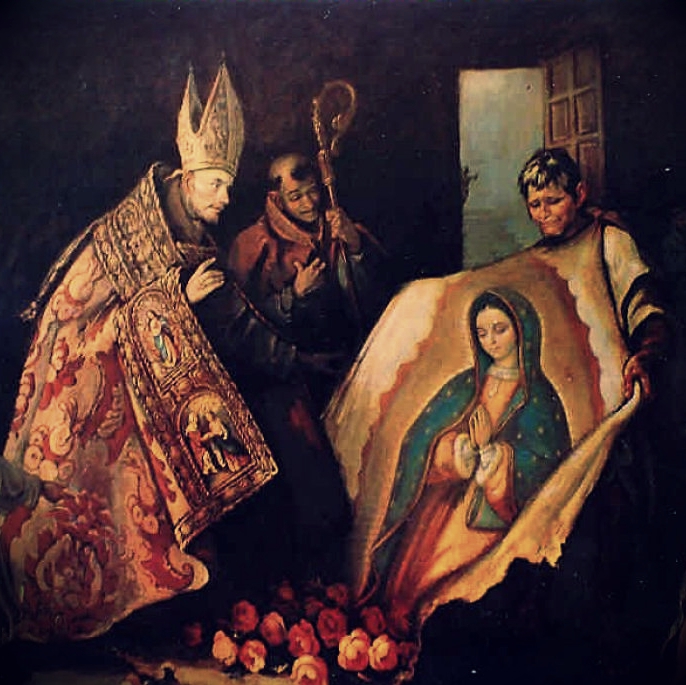
…her clothing was shining like the sun, as if it were sending out waves of light, and the stone, the crag on which she stood, seemed to be giving out rays. —Nican Mopohua, Don Antonio Valeriano (c. 1520-1605 A.D,), n. 17-18
As a miraculous sign of her presence, she left Castilian roses growing on the hillside, which are native only to Spain. When St. Juan gathered the flowers in his robe to show the bishop, a Spaniard, Our Lady suddenly appeared on the tilma right in front of his eyes. God used this apparition and the image on the tilma to evangelize the people and bring human sacrifice to an end, converting up to nine million Aztecs to Christianity. The image of Our Lady on St. Juan’s tilma hangs to this day in the Basilica in Mexico City. Scientists have confirmed that the image is miraculous, its “paint” of an unknown substance.[7]Read more about the miraculous image here.
The Catechism of the Catholic Church puts it all into perspective:
Mary’s function as mother of men in no way obscures or diminishes this unique mediation of Christ, but rather shows its power. But the Blessed Virgin’s salutary influence on men… flows forth from the superabundance of the merits of Christ, rests on His mediation, depends entirely on it, and draws all its power from it. —n. 970
Trust in Jesus. He sent me, and Heaven is present here. —Our Lady to Pedro Regis, January 17, 2026
Related Reading
So grateful for your prayers and support.
Thank you!

To journey with Mark in The Now Word,
click on the banner below to subscribe.
Your email will not be shared with anyone.
Now on Telegram. Click:

Follow Mark and the daily “signs of the times” on MeWe:
Follow Mark’s writings here:
Listen on the following:




Footnotes
| ↑1 | Note: when the angel Gabriel greets Mary in Luke 1:28, he says, “Hail, full of grace! The Lord is with you” [as translated by St. Jerome in the Latin Vulgate]. Luke’s use of the Greek word kecharitōmenē for “full of grace” indicates that God has already “graced” Mary previous to this point, making her a vessel who “has been” and “is now” filled with divine life [footnote RSV]. Because Mary held within her womb the “Word of God”, the Ark of the Covenant is seen as a type of the Virgin Mary. And the Ark was required to be made of “pure gold” [cf. Exodus 25:11]. |
|---|---|
| ↑2 | December 8, 1854; when a pope “defines”, he is not creating a new dogma but affirming what the Church has always believed. |
| ↑3 | The Scriptures teach that Jesus is essentially the “new Adam” in 1 Corinthians 15:22: “For just as in Adam all die, so too in Christ shall all be brought to life.” As such, the Early Church Fathers saw Mary as the “new Eve.” Church Father St. Irenaeus (c. 125 – c. 202 AD) wrote: “He, having been made Himself the beginning of those that live, as Adam became the beginning of those who die. Wherefore also Luke, commencing the genealogy with the Lord, carried it back to Adam, indicating that it was He who regenerated them into the Gospel of life, and not they, Him. And thus also it was that the knot of Eve’s disobedience was loosed by the obedience of Mary. For what the virgin Eve had bound fast through unbelief, this did the virgin Mary set free through faith” [Against Heresies (Book III, Chapter 22). And who was Eve again? Genesis 3:20: “The man gave his wife the name ‘Eve,’ because she was the mother of all the living.” |
| ↑4 | 2 Maccabees 15:11-16 |
| ↑5 | or Hermon; the text simply says “a high mountain” |
| ↑6 | eg. St. Joseph, St. Dominic Savio, St. Anne, St. Thérèse de Liseux, St. Charbel, etc. |
| ↑7 | Read more about the miraculous image here. |