
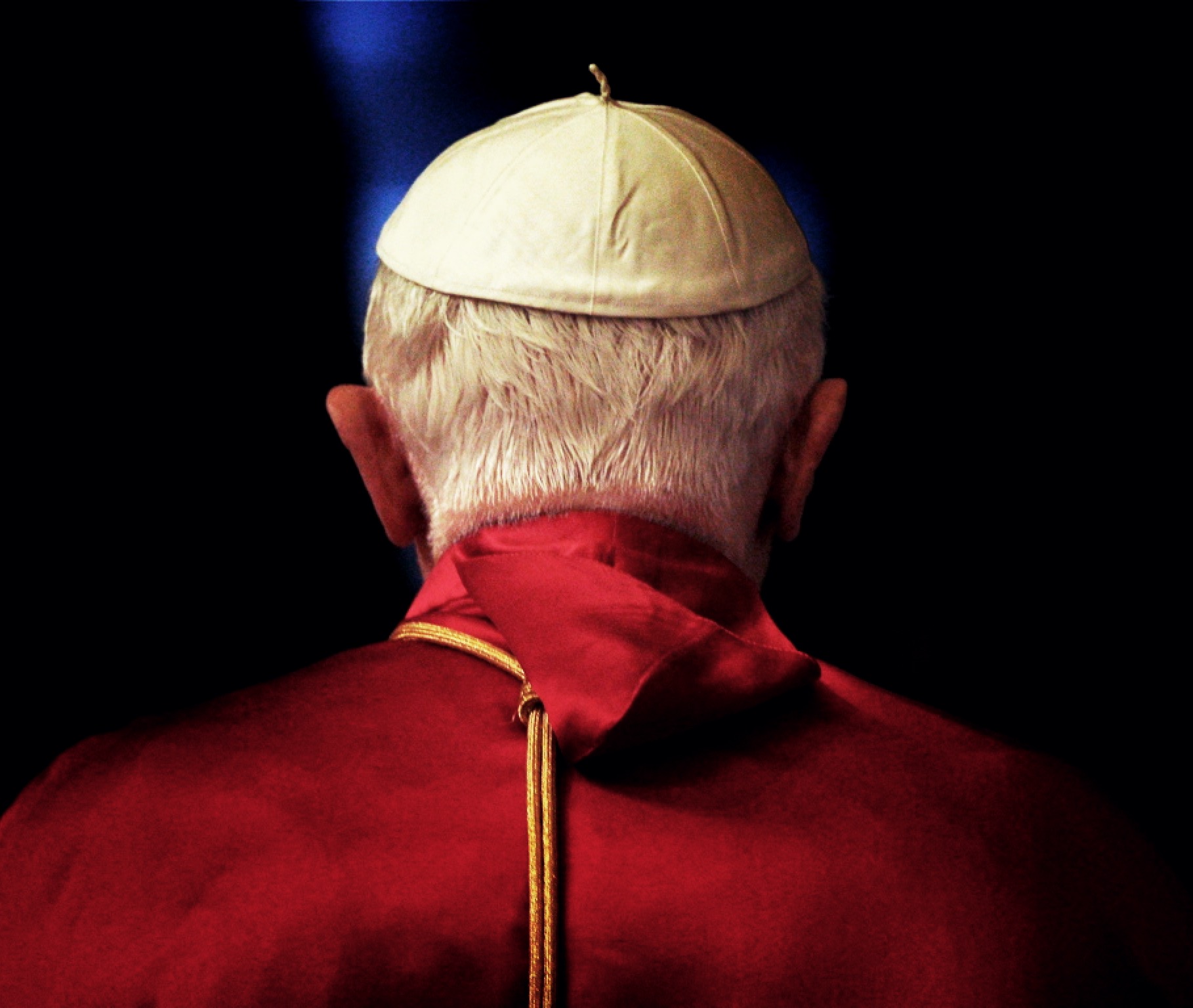
With dozens of new subscribers coming on board now each week, old questions are popping up such as this one: Why aren’t the Pope’s speaking about the end times? The answer will surprise many, reassure others, and challenge many more. First published September 21st, 2010, I have updated this writing to the present pontificate.
I receive letters from time to time asking, “If we are possibly living in the “end times,” then why wouldn’t the popes be shouting this from the rooftops?” My response is: “If they are, is anyone listening?”
The fact is, this entire blog, my book, my webcast—which are intended to prepare the reader and viewer for the times which are here and coming—are based on what the Holy Fathers have been preaching for over a century. And they have been consistently warning, with greater and greater frequency, that the path of mankind is leading to “destruction” unless we embrace once again the Good News and the One who is Good: Jesus Christ.
It is not I, but Paul VI who said:
There is a great uneasiness at this time in the world and in the Church, and that which is in question is the faith. It so happens now that I repeat to myself the obscure phrase of Jesus in the Gospel of St. Luke: ‘When the Son of Man returns, will He still find faith on the earth?’…I sometimes read the Gospel passage of the end times and I attest that, at this time, some signs of this end are emerging. —POPE PAUL VI, The Secret Paul VI, Jean Guitton, p. 152-153, Reference (7), p. ix.
Echoing the words of St. Paul that an ‘apostasy’, a great falling away from the faith would precede the Antichrist or “son of perdition” (2 Thess 2), Paul VI said:
The tail of the devil is functioning in the disintegration of the Catholic world. The darkness of Satan has entered and spread throughout the Catholic Church even to its summit. Apostasy, the loss of the faith, is spreading throughout the world and into the highest levels within the Church. —Address on the Sixtieth Anniversary of the Fatima Apparitions, October 13, 1977; reported in the Italian paper Corriere della Sera on Page 7, October 14, 1977 issue; NOTE: while this has been quoted by several contemporary writers, including theologians versed in patrisitics, I have been unable to recover the original source of this statement, which would have been in either Italian or Latin. Archives of Corrieree della Sera do not show this passage.
This apostasy has been brewing for centuries. But it has been particularly in the last century or so that the Holy Father’s have begun to identify it more concretely as the “apostasy” of the last times. At the turn of the 19th century, Pope Leo XIII stated in his encyclical on the Holy Spirit:
…he who resists the truth through malice and turns away from it, sins most grievously against the Holy Ghost. In our days this sin has become so frequent that those dark times seem to have come which were foretold by St. Paul, in which men, blinded by the just judgment of God, should take falsehood for truth, and should believe in “the prince of this world,” who is a liar and the father thereof, as a teacher of truth: “God shall send them the operation of error, to believe lying (2 Thess. ii., 10). In the last times some shall depart from the faith, giving heed to spirits of error and the doctrines of devils” (1 Tim. iv., 1). —Divinum Illud Munus, n. 10
Pope Francis describes the apostasy as a “negotiation” with the “spirit of worldliness”:
…worldliness is the root of evil and it can lead us to abandon our traditions and negotiate our loyalty to God who is always faithful. This… is called apostasy, which… is a form of “adultery” which takes place when we negotiate the essence of our being: loyalty to the Lord. —POPE FRANCIS from a homily, Vatican Radio, November 18th, 2013
Francis has, in fact, not been shy in mentioning at least twice now a book written over a hundred years ago called Lord of the World. It is a remarkably prescient book about the rise of Antichrist that eerily parallels our times. It is what has perhaps inspired Francis on several occasions to rightly warn of “unseen empires” [1]cf. Address to European Parliament, Strasbourg, France, Nov. 25th, 2014, Zenit who are manipulating and coercing nations into a single paradigm.
It is not the beautiful globalization of unity of all Nations, each one with their own customs, instead it is the globalization of hegemonic uniformity, it is the single thought. And this sole thought is the fruit of worldliness. —POPE FRANCIS, Homily, November 18th, 2013; Zenit
Masters of conscience … Even in today’s world , there are so many. —Homily at Casa Santa Martha, May 2nd, 2014; Zenit.org
This came across clearly when he warned against the widespread indoctrination of children:
The horrors of the manipulation of education that we experienced in the great genocidal dictatorships of the twentieth century have not disappeared; they have retained a current relevance under various guises and proposals and, with the pretense of modernity, push children and young people to walk on the dictatorial path of “only one form of thought”. —POPE FRANCIS, message to members of BICE (International Catholic Child Bureau); Vatican Radio, April 11th, 2014
Speaking of Antichrist, the conditions for his emergence are not the stuff of merely novels. It was Pius X who suggested that this lawless one could be on earth even now:
Who can fail to see that society is at the present time, more than in any past age, suffering from a terrible and deep-rooted malady which, developing every day and eating into its inmost being, is dragging it to destruction? You understand, Venerable Brethren, what this disease is—apostasy from God… When all this is considered there is good reason to fear lest this great perversity may be as it were a foretaste, and perhaps the beginning of those evils which are reserved for the last days; and that there may be already in the world the “Son of Perdition” of whom the Apostle speaks. —POPE ST. PIUS X, E Supremi, Encyclical On the Restoration of All Things in Christ, n. 3, 5; October 4th, 1903
Focusing on societal upheavals, his successor, Benedict XV, wrote in the Encyclical Letter, Ad Beatissimi Apostolorum:
Certainly those days would seem to have come upon us of which Christ Our Lord foretold: “You shall hear of wars and rumours of wars—for nation shall rise against nation, and kingdom against kingdom“ (Matt 24:6-7). —November 1, 1914; www.vatican.va
Pius XI also applied the end time passage of Matthew 24 to our times:
And thus, even against our will, the thought rises in the mind that now those days draw near of which Our Lord prophesied: “And because iniquity hath abounded, the charity of many shall grow cold” (Matt. 24:12). —POPE PIUS XI, Miserentissimus Redemptor, Encyclical on Reparation to the Sacred Heart, n. 17
Like Pius X, he too foresaw, particularly in the spread of Communism, foreshadowings of the coming of Antichrist:
These things in truth are so sad that you might say that such events foreshadow and portend the “beginning of sorrows,” that is to say of those that shall be brought by the man of sin, “who is lifted up above all that is called God or is worshiped“ (2 Thes 2:4). —Miserentissimus Redemptor, Encyclical Letter on Reparation to the Sacred Heart, May 8th, 1928; www.vatican.va
It was John Paul II who, standing in the Divine Mercy Basilica in Poland, quoted the diary of St. Faustina:
From here [Poland] must go forth the ‘spark which will prepare the world for [Jesus’] final coming’ (see Diary, 1732). This spark needs to be lighted by the grace of God. This fire of mercy needs to be passed on to the world. —POPE JOHN PAUL II, at the consecration of the Divine Mercy Basilica in Cracow, Poland, 2002.
Two years before assuming the papacy, he described the boundaries of this epic battle before us:
We are now facing the final confrontation between the Church and the anti-church, between the Gospel and the anti-gospel, between Christ and the antichrist. This confrontation lies within the plans of divine Providence; it is a trial which the whole Church, and the Polish Church in particular, must take up. It is a trial of not only our nation and the Church, but in a sense a test of 2,000 years of culture and Christian civilization, with all of its consequences for human dignity, individual rights, human rights and the rights of nations. —Cardinal Karol Wojtyla (JOHN PAUL II ), at the Eucharistic Congress, Philadelphia, PA for the bicentennial celebration of the signing of the Declaration of Independence; some citations of this passage include the words “Christ and the antichrist” as above. Deacon Keith Fournier, an attendee, reports it as above; cf. Catholic Online; August 13, 1976
The “anti-Church” and “anti-Gospel” may be nothing more than ‘code words for “anti-Christ,”‘ — so, apparently, said renowned Catholic theologian, Dr. Peter Kreeft, in a lecture one my readers attended. In fact, John Paul II went so far as to suggest just what the “end times” looks like: a battle between the “culture of life” and the “culture of death”:
This struggle parallels the apocalyptic combat described in [Rev 11:19-12:1-6, 10 on the battle between” the woman clothed with the sun” and the “dragon”]. Death battles against Life: a “culture of death” seeks to impose itself on our desire to live, and live to the full… Vast sectors of society are confused about what is right and what is wrong, and are at the mercy of those with the power to “create” opinion and impose it on others. —POPE JOHN PAUL II, Cherry Creek State Park Homily, Denver, Colorado, 1993
The following year, he evoked this biblical image again:
…an image, which has its expression even in our times, especially in the Year of the Family. When in fact before the woman accumulate all the threats against life that it is going to bring into the world, we must turn to the woman clothed with the sun [the Blessed Mother]… —Regina Coeli, April 24h, 1994; vatican.ca
He then called the Church to remember the prayer to St. Michael the Archangel, penned in 1884 by Leo XIII, who allegedly heard a supernatural conversation where Satan asked for a century to test the Church. [2]cf. Aleteia
Although today this prayer is no longer recited at the end of the Eucharistic celebration, I invite everyone not to forget it, but to recite it to receive help in the battle against the forces of darkness and against the spirit of this world. —Ibid.
I ask again, is anyone listening? Does anyone care what the successor to Peter is saying? Because he is the shepherd Christ appointed over His sheep on earth (Jn 21:17). Christ would speak through him if indeed he was willing to speak. And if the pope spoke in his capacity as shepherd and teacher, Jesus would say again:
Whoever listens to you listens to me. Whoever rejects you rejects me. (Luke 10:16)
In a talk with pilgrims in Germany, Pope John Paul gave what is perhaps the most stark and specific papal warning regarding a coming tribulation:
We must be prepared to undergo great trials in the not-too-distant future; trials that will require us to be ready to give up even our lives, and a total gift of self to Christ and for Christ. Through your prayers and mine, it is possible to alleviate this tribulation, but it is no longer possible to avert it, because it is only in this way that the Church can be effectively renewed. How many times, indeed, has the renewal of the Church been effected in blood? This time, again, it will not be otherwise. We must be strong, we must prepare ourselves, we must entrust ourselves to Christ and to His Mother, and we must be attentive, very attentive, to the prayer of the Rosary. —POPE JOHN PAUL II, interview with Catholics at Fulda, Germany, Nov. 1980; www.ewtn.com
THE TRUMPET OF BENEDICT
Blow the trumpet in Zion, sound the alarm on my holy mountain! Let all who dwell in the land tremble, for the day of the LORD is coming. (Joel 2:1)
According to biblical exegesis, Zion is a symbol or type of the Church. Pope Benedict had been consistently and loudly blowing the trumpet from its summit for some time, such as during his trip to Britain:
No one who looks realistically at our world today could think that Christians can afford to go on with business as usual, ignoring the profound crisis of faith which has overtaken our society, or simply trusting that the patrimony of values handed down by the Christian centuries will continue to inspire and shape the future of our society. —POPE BENEDICT XVI, London, England, September 18th, 2010; Zenit
Now, I am not certain what happens when the average Catholic reads such a statement. Do we turn the page and continue sipping our coffee, or do we pause for a moment to reflect on the profound and personal call these words evoke? Or have our hearts become so dulled by the spirit of the age, so muted by political correctness, or perhaps hardened by the sin, riches, and comforts of our day that such a stark warning glances off our souls like an arrow off of steel?
He went on to say:
…an intellectual and moral relativism threatens to sap the very foundations of our society. —POPE BENEDICT XVI, Ibid.
We are not speaking here of a British problem or an American or Polish issue, but of a global foundation. “It is a trial which the whole Church must take up,” said John Paul II, “…a test of 2,000 years of culture and Christian civilization… and the rights of nations.”
Even Pope Benedict seemed to allude to the possibility of a world dictator when he said that there is a growing…
…dictatorship of relativism that recognizes nothing as definite, and which leaves as the ultimate measure only one’s ego and desires. Having a clear faith, according to the credo of the Church, is often labeled as fundamentalism. Yet, relativism, that is, letting oneself be tossed and ‘swept along by every wind of teaching’, appears the sole attitude acceptable to today’s standards. —Cardinal Ratzinger (POPE BENEDICT XVI) pre-conclave Homily, April 18th, 2005
Related to this, Pope Benedict directly compares the Revelation Ch. 12 to the attack upon truth in our times:
This fight in which we find ourselves… [against] powers that destroy the world, are spoken of in chapter 12 of Revelation… It is said that the dragon directs a great stream of water against the fleeing woman, to sweep her away… I think that it is easy to interpret what the river stands for: it is these currents that dominate everyone, and want to eliminate the faith of the Church, which seems to have nowhere to stand before the power of these currents that impose themselves as the only way of thinking, the only way of life. —POPE BENEDICT XVI, first session of the special synod on the Middle East, October 10th, 2010
Jesus warned that many “False messiahs and false prophets will arise, and they will perform signs and wonders so great as to deceive, if that were possible, even the elect” (Matt 24:24). Where does intellectual and moral relativism come from but false prophets—those university professors, politicians, authors, professional atheists, Hollywood producers, and yes, even fallen church leaders who no longer recognize the immutable laws of nature and God? And who are those false messiahs but those who disregard the pronouncements of the Savior and become their own savior, a law unto themselves?
Speaking of the situation that is spreading across the planet, Pope Benedict wrote a clear and unequivocal letter to the Bishops of the world:
In our days, when in vast areas of the world the faith is in danger of dying out like a flame which no longer has fuel, the overriding priority is to make God present in this world and to show men and women the way to God… The real problem at this moment of our history is that God is disappearing from the human horizon, and, with the dimming of the light which comes from God, humanity is losing its bearings, with increasingly evident destructive effects. —Letter of His Holiness Pope Benedict XVI to All the Bishops of the World, March 10, 2009; Catholic Online
The effects, such as abortion, euthanasia, and the redefinition of marriage, said his predecessor, need to be called out on the carpet for what they are: murderous, unjust, and inordinate.
Given such a grave situation, we need now more than ever to have the courage to look the truth in the eye and to call things by their proper name, without yielding to convenient compromises or to the temptation of self-deception. In this regard, the reproach of the Prophet is extremely straightforward: “Woe to those who call evil good and good evil, who put darkness for light and light for darkness” (Is 5:20). —POPE JOHN PAUL II, Evangelium Vitae “The Gospel of Life”, n. 58
Benedict echoed that “woe” shortly after becoming pope:
The threat of judgment also concerns us, the Church in Europe, Europe and the West in general… the Lord is also crying out to our ears… “If you do not repent I will come to you and remove your lampstand from its place.” Light can also be taken away from us and we do well to let this warning ring out with its full seriousness in our hearts, while crying to the Lord: “Help us to repent!” —Pope Benedict XVI, Opening Homily, Synod of Bishops, October 2nd, 2005, Rome.
What is this judgment? Is it thunderbolts from Heaven? No, the “destructive effects” are what a world will bring down on itself by ignoring our consciences, disobeying God’s word, and creating a new world on the shifting sands of materialism and relativism as the fruits of a culture of death—fruits few have yet anticipated.
Today the prospect that the world might be reduced to ashes by a sea of fire no longer seems pure fantasy: man himself, with his inventions, has forged the flaming sword [of the angel of justice that appeared in Fatima]. —Cardinal Joseph Ratzinger, (POPE BENEDICT XVI), The Message of Fatima, from the Vatican’s website
Benedict zeros in on technology, ranging from reproductive and experimental technologies to military and ecological:
If technical progress is not matched by corresponding progress in man’s ethical formation, in man’s inner growth (cf. Eph 3:16; 2 Cor 4:16), then it is not progress at all, but a threat for man and for the world. —POPE BENEDICT XVI, Encyclical Letter, Spe Salvi, n. 22
Whoever wants to eliminate love is preparing to eliminate man as such. —POPE BENEDICT XVI, Encyclical Letter, Deus Caritas Est (God is Love), n. 28b
These are frank warnings that find their locus in the phenomenon of “globalization” and what Benedict called a “global force” that is threatening freedom.
…without the guidance of charity in truth, this global force could cause unprecedented damage and create new divisions within the human family… …humanity runs new risks of enslavement and manipulation. —POPE BENEDICT XVI, Caritas in Veritate, n. 33
The connection to Revelation 13 is obvious. For the beast that rises also seeks to dominate and enslave the world. In that regard, Pope Benedict was merely echoing the fears of his predecessors who directly identified those who seemed to be propelling this beast to the forefront:
At this period, however, the partisans of evil seems to be combining together, and to be struggling with united vehemence, led on or assisted by that strongly organized and widespread association called the Freemasons. No longer making any secret of their purposes, they are now boldly rising up against God Himself …that which is their ultimate purpose forces itself into view—namely, the utter overthrow of that whole religious and political order of the world which the Christian teaching has produced, and the substitution of a new state of things in accordance with their ideas, of which the foundations and laws shall be drawn from mere naturalism. —POPE LEO XIII, Humanum Genus, Encyclical on Freemasonry, n.10, Apri 20th, 1884
Indicating that this ‘overthrow’ of the nations was far advanced, Pope Benedict compared our times to the collapse of the Roman Empire noting how evil became unrestrained once the foundations of morality crumbled—which is precisely the first goal of these aforementioned secret societies.
The disintegration of the key principles of law and of the fundamental moral attitudes underpinning them burst open the dams which until that time had protected peaceful coexistence among peoples. The sun was setting over an entire world. Frequent natural disasters further increased this sense of insecurity. There was no power in sight that could put a stop to this decline. All the more insistent, then, was the invocation of the power of God: the plea that he might come and protect his people from all these threats. —POPE BENEDICT XVI, Address to the Roman Curia, December 20th, 2010
Of course, he was only echoing what he had said while still a Cardinal, that moral relativism was threatening the very future of a world that cannot function with disregard for the absolutes of the moral natural law.
Only if there is such a consensus on the essentials can constitutions and law function. This fundamental consensus derived from the Christian heritage is at risk… In reality, this makes reason blind to what is essential. To resist this eclipse of reason and to preserve its capacity for seeing the essential, for seeing God and man, for seeing what is good and what is true, is the common interest that must unite all people of good will. The very future of the world is at stake. —Ibid.
Returning again to Pope Francis, he has taken this a step further calling the forces behind the manipulation of economies, nations, and people’s a new god.
A new tyranny is thus born, invisible and often virtual, which unilaterally and relentlessly imposes its own laws and rules… In this system, which tends to devour everything which stands in the way of increased profits, whatever is fragile, like the environment, is defenseless before the interests of a deified market, which become the only rule. —POPE FRANCIS, Evangelii Gaudium, n. 56
Indeed, in Revelation 13 we read that the beast that rises, this global economic and political power, forces everyone to worship it and “to cause those who would not worship the image of the beast to be slain.” [3]cf. Rev 13:15 The means of control is a “mark” which everyone must have in order to participate in this new world order. It is worth noting, then, what Pope Benedict said as a Cardinal:
The Apocalypse speaks about God’s antagonist, the beast. This animal does not have a name, but a number. In [the horror of the concentration camps], they cancel faces and history, transforming man into a number, reducing him to a cog in an enormous machine. Man is no more than a function. In our days, we should not forget that they prefigured the destiny of a world that runs the risk of adopting the same structure of the concentration camps, if the universal law of the machine is accepted. The machines that have been constructed impose the same law. According to this logic, man must be interpreted by a computer and this is only possible if translated into numbers. The beast is a number and transforms into numbers. God, however, has a name and calls by name. He is a person and looks for the person. —Cardinal Ratzinger, (POPE BENEDICT XVI) Palermo, March 15th, 2000 (italics added)
As if returning to this thought, Pope Benedict stated:
We think of the great powers of the present day, of the anonymous financial interests which turn men into slaves, which are no longer human things, but are an anonymous power which men serve, by which men are tormented and even slaughtered. They are a destructive power, a power that menaces the world. —BENEDICT XVI, Reflection after the reading of the office for the Third Hour, Vatican City, October 11,
2010
LANGUAGE
The elimination of love… of man… of God. How can we fail to hear that these are not ordinary times? Perhaps the issue here is one of language. Catholics have been so remiss to speak of the “end times” for fear of being ridiculed that we have left the discussion almost entirely to apocalyptic sects who proclaim the end of the world is nigh, to Hollywood and their exaggerated spectacles of despair, or others who, without the light of Sacred Tradition, propose dubious interpretations of Scripture that include such scenarios as “the rapture.”
The widespread reluctance on the part of many Catholic thinkers to enter into a profound examination of the apocalyptic elements of contemporary life is, I believe, part of the very problem which they seek to avoid. If apocalyptic thinking is left largely to those who have been subjectivized or who have fallen prey to the vertigo of cosmic terror, then the Christian community, indeed the whole human community, is radically impoverished. And that can be measured in terms of lost human souls. –Author, Michael D. O’Brien, Are We Living In Apocalyptic Times?
In reality, the popes have been speaking—no, shouting—about the times we are in, albeit, couched at times in different terms (though the use of the words ‘apostasy’, ‘son of perdition,’ and ‘signs of the end’ are not vague at all.) The language of evangelical Christians who frequently use the term “end times” is often centered on “getting saved” before “the rapture.” But the Holy Fathers, drawing upon the entire deposit of faith, while indeed calling souls into a personal relationship with Jesus, have been aiming directly at the political-philosophical underpinnings that undermine the value and dignity of the human person, the divinity of Christ, and the very existence of the Creator. While calling each soul into a personal encounter with Christ, they have also raised their voice for the common good recognizing that both individual souls and the collective whole have reached a dangerous threshold. And since we do not know “the day or the hour,” the Holy Fathers have been most prudent to avoid declaring that this or that generation is the one who will encounter the final days of this age.
Are we close to the end? This we will never know. We must always hold ourselves in readiness, but everything could last a very long time yet. —POPE PAUL VI, The Secret Paul VI, Jean Guitton, p. 152-153, Reference (7), p. ix.
OUR RESPONSE
There is no longer time to capitulate to those who suggest that an examination of our times in light of what has just been said, or the Scriptural signs that describe the end of the age, is fear-mongering, an unhealthy pre-occupation, or just too frightening. To ignore these popes and pass over such profound warnings is spiritually reckless and dangerous. Souls are at stake here. Souls are at stake! Our response should not be one of self-preservation, but compassion. Truth is being extinguished in the world, truth that would set souls free. It is being silenced, distorted, and inverted. The cost of this is souls.
But what am I saying? To even mention “Hell” today induces head-shaking among more politically correct Catholics. And so I ask, what are we doing? Why are we bothering to propose the truth, attend our weekly Masses, and raise our children as Catholics? If everyone ends up in Heaven, why are we bothering to mortify our passions, tame our flesh, and moderate pleasure? Why are popes traversing the globe, challenging governments, and alerting the faithful with such strong language? [4]cf. Hell is for Real
The answer is souls. That as I write, some are entering that eternal and sorrowful fire to be separated from God, from love, light, peace, and hope, for all eternity. If this does not disturb us, if it does not move us to compassionate action let alone shake us from our own sin, then as Christians, our inner compass has gone terribly off course. I hear again with great force the words of Jesus: [5]cf. First Love Lost
…you have lost the love you had at first. Realize how far you have fallen. Repent, and do the works you did at first. Otherwise, I will come to you and remove your lampstand from its place, unless you repent. (Rev 2:2-5)
Among Catholics who are aware of the times we are in, there are many discussions of refuges, food supplies, and living off the grid. Be practical, but make souls your project, make souls your battle cry!
Whoever seeks to preserve his life will lose it… and whoever loses his life for my sake will find it. (Luke 17:33, Matt 10:39)
We must put priorities back in place: to love the Lord our God with all our heart, soul, and strength and our neighbour as oneself. That presumes a deep and predominate concern for our neighbour’s salvation.
[The Church] exists in order to evangelize… —POPE PAUL VI, Evangelii Nuntiandi, n. 24
And to witness Jesus to our neighbour, to speak the truth today will exact a cost, as Benedict reminded us again in Britain:
In our own time, the price to be paid for fidelity to the Gospel is no longer being hanged, drawn and quartered but it often involves being dismissed out of hand, ridiculed or parodied. And yet, the Church cannot withdraw from the task of proclaiming Christ and his Gospel as saving truth, the source of our ultimate happiness as individuals and as the foundation of a just and humane society. —POPE BENEDICT XVI, London, England, September 18th, 2010; Zenit
The popes are shouting to the four corners of the earth that foundations are trembling and ancient edifices are about to collapse; that we are on the threshold of the end of our age—and the beginning of a new age, a new era. [6]cf. The Popes, and the Dawning Era Our personal response must be nothing short of what our Lord Himself asks: to pick up our cross, renounce our possessions, and follow Him. Earth is not our home; the kingdom we seek is not to be our own but His. Bringing as many souls with us into it as we can is our mission, by His grace, according to His plan, unfolding now before our very eyes in these, the end times.
Be prepared to put your life on the line in order to enlighten the world with the truth of Christ; to respond with love to hatred and disregard for life; to proclaim the hope of the risen Christ in every corner of the earth. —POPE BENEDICT XVI, Message to the Young People of the World, World Youth Day, 2008
Thanks for your support
of this full-time ministry!

To subscribe, click here.
Spend 5 minutes a day with Mark, meditating upon the daily Now Word in the Mass readings
for these forty days of Lent.
A sacrifice that will feed your soul!
SUBSCRIBE here.

Footnotes
| ↑1 | cf. Address to European Parliament, Strasbourg, France, Nov. 25th, 2014, Zenit |
|---|---|
| ↑2 | cf. Aleteia |
| ↑3 | cf. Rev 13:15 |
| ↑4 | cf. Hell is for Real |
| ↑5 | cf. First Love Lost |
| ↑6 | cf. The Popes, and the Dawning Era |